


Worried about choosing the right NC personal injury law firm for you?

Here’s guidance on finding a team who will stand beside you throughout your case.

This page refers to How to Choose the Right North Carolina Personal Injury Law Firm for You.
Since laws differ between states, if you are located in South Carolina, please click here.
How to Choose the Right North Carolina Personal Injury Law Firm for You
Choosing a personal injury law firm to help you is not an easy decision, but it is a critical one. There’s nothing wrong with comparing several firms before deciding which one is right for you. The individual attorney matters, but so do the experience, resources, communication practices, and support available across the firm.
You want your attorney and legal team to be:
- Clear and responsive communicators
- Compassionate and attentive to your needs
- Experienced with your type of personal injury claim
- Thorough investigators
- Strong negotiators and advocates
- Prepared to pursue litigation when necessary
We won’t say we’re the best personal injury law firm in North Carolina. In fact, there are ethical rules that prevent lawyers or law firms from claiming to be the best. Finding the best personal injury representation is a subjective choice. Whether an attorney or firm is right for you is a decision only you can make. But making that decision may not be easy.
Can you determine whether an attorney and their firm meets your qualifications just by reading a website? A firm’s site is a useful starting point, but it should not be the only source you review. Look for information that can be verified through attorney biographies, client reviews, case results, professional recognition, State Bar records, and published selection standards.

You can check the North Carolina State Bar or another licensing body website to see if the attorney has ethics complaints filed against them — or even any suspensions or disbarments. But that’s only part of the picture.
You could use a lawyer referral service, but you’ll still have to do your homework on the referral service. Do they carefully screen their list for the right match for you or do they list all attorneys in good standing with the North Carolina State Bar?
Even if the referral service screens its attorneys, many people prefer to do the screening themselves – after all, who knows you better?
But how do you choose the best personal injury lawyer for you when there are so many? There are three common ways: asking family and friends, reading online reviews, and looking at third-party ratings and peer recognition.
Asking Family and Friends
Asking family, friends, and acquaintances who live and work in North Carolina for recommendations is the first step for many people in searching for the right personal injury lawyer. If someone you trust had a good experience with an attorney who practices in the area you need help with, then your search may be at an end.
However, each attorney-client relationship is different, so another’s experience may be different than your own. Only by meeting with that attorney can you determine if the attorney that they like is one you will, too.
Reading Online Reviews
Client reviews can provide useful insight into communication, responsiveness, professionalism, and how people felt they were treated during the legal process. Look for patterns across multiple reviews rather than relying on one unusually positive or negative comment.
Pay particular attention to whether former clients consistently mention that the firm:
- Explained the process clearly
- Returned calls or messages
- Provided regular updates
- Treated them with respect and compassion
- Helped reduce the stress of managing a claim
- Followed through on commitments
Reviews should be considered alongside relevant experience, attorney qualifications, case results, fees, and independent professional recognition.
Third-Party Ratings and Peer Recognition
In addition to client reviews, third-party ratings and peer recognition can provide useful context about an attorney or law firm. Before relying on an award or ranking, review:
- Who issued the recognition
- Whether it applies to the firm or an individual attorney
- Whether it relates to personal injury law
- The year the recognition was received
- Whether the organization publishes its selection process
- Whether payment is required to be considered or displayed
Examples of legal recognition sources include Martindale-Hubbell, Best Lawyers, Best Law Firms, and Super Lawyers. Each organization uses its own methodology, so recognition should be reviewed alongside relevant experience, results, client feedback, resources, and attorney qualifications.
Farrin’s Professional Recognition
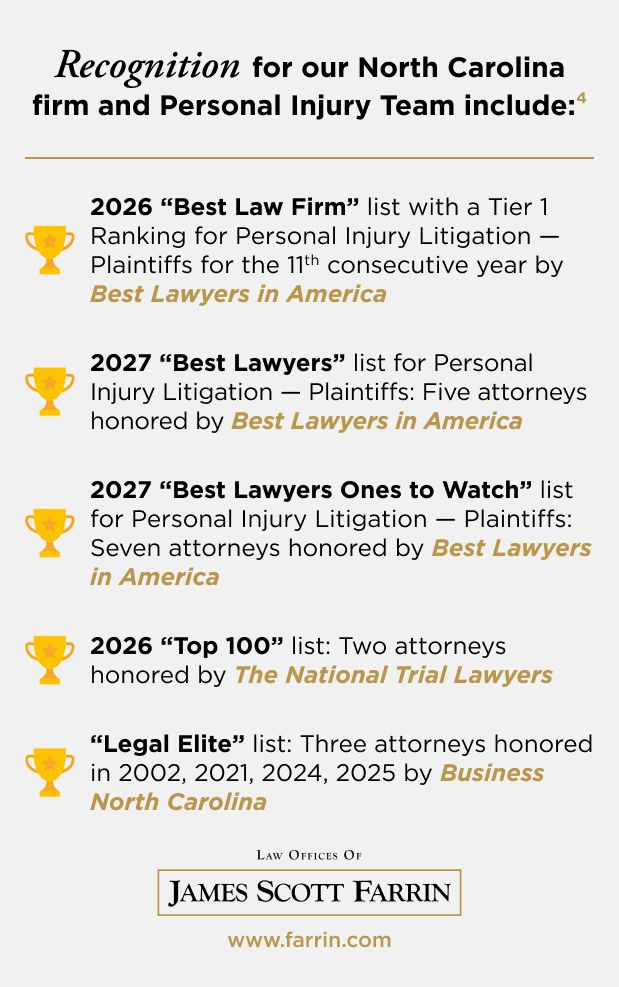
The Law Offices of James Scott Farrin and individual attorneys at the firm have received professional and peer recognition.⁴ Relevant recognition includes listings associated with personal injury litigation and other areas of law handled by the firm.
When reviewing Farrin’s awards, prospective clients should consider:
- Whether the recognition applies to the firm or an individual attorney
- The practice area associated with the recognition
- The year it was received
- The issuing organization
- The organization’s published standards for inclusion
How to Evaluate North Carolina Personal Injury Law Firms: 10 Questions to Ask
The steps above can help you create a list of attorneys and law firms to consider. The next step is to evaluate their experience, results, resources, communication practices, and professional reputation.
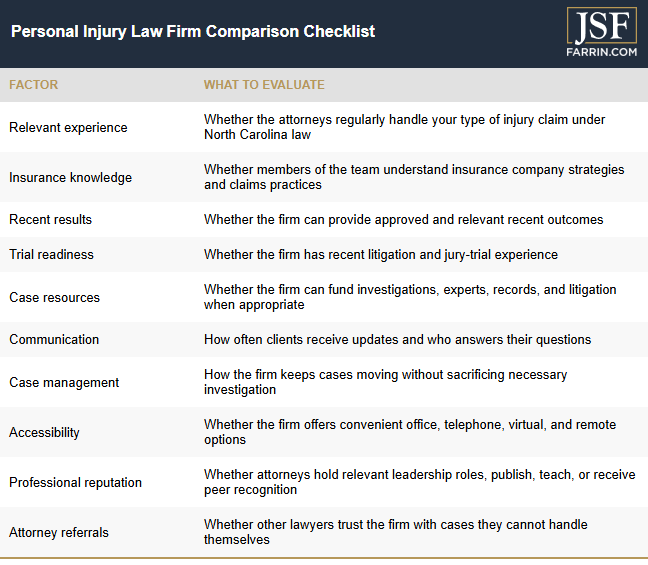
These 10 questions can help you evaluate both the attorney you may work with and the firm that will support your claim.
Personal Injury Law Firm Evaluation Checklist
Questions 1-3: Experience and Results
Question #1: How many years of legal experience do your attorneys have?
This is the natural first question to ask, but total years of practice should not be the only measure. Does the attorney regularly handle the type of personal injury claim you have? Does the firm have experience applying the North Carolina laws that may affect your case? Will the attorney collaborate with colleagues as needed who have relevant litigation, insurance, medical, or case-specific experience?
Why It Matters: The law is complex. An experienced attorney has gone through this process many times before and knows the ropes. An experienced attorney also knows the strategy and tactics the other side is likely to use. Having someone with that knowledge and skill on your side can be a huge advantage.
Why North Carolina Personal Injury Experience Matters: Personal injury laws vary by state. When choosing a firm, ask whether their attorneys regularly handle claims involving North Carolina liability rules, filing deadlines, insurance requirements, damages, and court procedures.
North Carolina follows a contributory negligence rule. Depending on the circumstances, an insurer or defendant may argue that an injured person’s own actions prevent recovery. A firm’s ability to investigate fault, preserve evidence, evaluate defenses, and apply North Carolina law is critical.
Question #2: Does your firm have attorneys who previously represented insurance companies?
It’s important to dig into the details of your attorney’s particular legal experience. Are they familiar with insurance company tactics? Have any attorneys at the firm worked as insurance adjusters?
Why It Matters: In many situations, you won’t be seeking compensation directly from the person who wronged you. Instead, you’ll be trying to recover the maximum from the insurance company through the insurance adjuster. The insurance adjuster is looking out for the insurance company’s best interests.
Why might the adjuster agree to pay out more on a claim? An attorney who used to work for insurance companies understands the priorities of large insurance companies.
Question #3: How much money has your firm recovered for clients in the past year?
Recent results can provide useful context, but the total amount recovered should not be the only factor you consider. Ask whether the firm has handled cases involving injuries, defendants, insurance issues, or legal challenges similar to yours.
When reviewing results, look for:
- The type of personal injury claim
- The injuries involved
- Whether the outcome was a settlement or verdict
- What investigation or litigation may have been required
- Whether multiple defendants or insurance policies were involved
- Appropriate disclaimers explaining that prior results do not guarantee a future outcome
Why It Matters: Money may not be the only factor, but it is certainly an important one. At the end of the day, you’re trying to recover maximum compensation. What success has the firm you’re considering had recently? That doesn’t mean your specific case will be successful, of course, but nobody can guarantee that.
Questions 4-5: Commitment to Your Case
These next questions are ones you should ask to assess how a law firm approaches their cases.
Question #4: How many jury trials has your firm had in the past year?
You may have no desire to go to trial and most cases don’t, but this is still an important question to ask. Is the firm willing to go to trial?
Why It Matters: When your attorney is backed by a strong team ready to take your opponent to court, you may have greater leverage in trying to negotiate for maximum compensation. Recent and consistent trials can show the other side you mean business.
Question #5: What resources can the firm use to investigate and support my case?
A larger firm may have access to more resources, but firm size alone does not show how those resources will be used. Ask what the firm may invest in investigating, documenting, negotiating, and litigating a claim when appropriate.
Why It Matters: A personal injury case may require medical records, investigators, expert analysis, depositions, court filings, or other case expenses. Ask how the firm decides which resources are necessary, who advances those costs, and how the team will investigate all reasonable sources of potential compensation before recommending next steps.
What You Should Ask About Attorney Fees and Case Costs: Before hiring a personal injury firm, ask for a clear explanation of the fee agreement and any costs that may be associated with the case.
Questions may include:
- Who advances costs for records, experts as needed, depositions, filing fees, and investigations?
- Are case costs deducted before or after the attorney fee is calculated?
- Could the client owe costs if there is no recovery?
- How will the final potential distribution be explained?
The answers should be included in the written fee agreement. Prospective clients should review that agreement carefully and ask questions before signing.
Questions 6-8: Working Together
These next questions focus on the logistics of your working relationship, including communication and location.
Question #6: Will you keep me in the loop on my case progress?
The last place you want to be is in the dark. Will your team be in touch often and let you know how things are going with your case?
Why It Matters: Your firm should value you and your case. Keeping in touch with you is one of the primary ways a firm can make you feel like you matter. What safeguards does the firm have in place so you’re not left wondering where things stand?
Questions may include:
- Will the attorney you initially speak with remain involved?
- Who will provide routine updates?
- Who will return calls and answer questions?
- Will other attorneys assist with strategy or litigation?
- What work may be handled by paralegals, case managers, investigators, or support staff?
- Who will appear in court if litigation becomes necessary?
The size of a firm does not determine the level of attention a client will receive. An important consideration is how the firm explains who will handle the case and how the team will communicate.
Question #7: How long do you expect my case to take?
This question gives you a glimpse into how your case is viewed and how it will be prioritized by your attorney.
Why It Matters: Asking this question allows you to see how the attorney sees your case. Do they see potential weaknesses that will take time to overcome? Even if the case needs time to develop, what safeguards does the firm have in place to keep cases moving quickly without sacrificing value?
Question #8: Where are you located? Are you near me?
This question may be more important to some than others, but that’s precisely the point. You’re looking for the best North Carolina personal injury attorney for you.
Why It Matters: Many clients want to sit face-to-face with their attorney in a local office. While a firm should offer the option to conduct business remotely, they should also have local offices so a client can schedule a visit when a call or email simply won’t do.
Questions 9-10: Peer Recognition
Question #9: What leadership positions do your firm’s attorneys have?
Ask how (and if) the attorneys at the firm you’re considering have been recognized by fellow professionals.
Why It Matters: Those who work in the field know it better than anyone. Do the attorneys in the law firm you’re considering hold positions, lecture, and write in the personal injury field? Attorneys chosen to prestigious leadership positions have earned the respect of their peers and strict selection committees.
Question #10: How many referrals do you get from other attorneys?
You should ask whether the attorney you’re interviewing (and their firm) receives referrals from other attorneys with cases that are too big or time-consuming for them to handle on their own.
Why It Matters: A referral from another lawyer means that lawyer has an interest in their referred case being successful. They have great incentive to refer cases they can’t personally handle to attorneys they believe will do right by the case.
More Signs to Consider Before Hiring a Personal Injury Firm
You may want to ask additional questions if:
- The firm guarantees a specific result.
- The fee agreement or responsibility for case costs is unclear.
- Case results are presented without context or required disclaimers.
- Awards are displayed without identifying the issuing organization or selection criteria.
- The firm has not explained its experience with your type of claim.
- Communication expectations feel vague.
- You feel pressured to sign before your questions are answered.
- The firm does not explain how it investigates or prepares cases.
No single factor automatically determines whether a firm is appropriate for you. The goal is to gather enough information to make an informed decision.
How Does Farrin Fare on the Factors Above?
The questions above can help you compare personal injury attorneys and law firms for you based on experience, results, resources, communication, accessibility, and professional reputation.
If you are considering the Law Offices of James Scott Farrin, review the firm’s answers below along with its attorney biographies, client feedback, case results, awards, and fee information.
Here is how Farrin addresses the 10 factors discussed above:
- Our attorneys, many of whom are recognized professionals in their fields, have won awards, authored books, and taught seminars for other attorneys.
- Our personal injury team includes attorneys and professionals with prior insurance-company, insurance-defense, claims-adjuster, or regulatory experience. These backgrounds help the firm anticipate the strategies insurers may use when evaluating and defending injury claims.
- In 2025, Farrin recovered more than $230 million in total for more than 4,500 clients.¹ Prospective clients should also review cases involving personal injuries.
- For 2026, our trial team was named a finalist for Litigation Department of the Year according to law.com’s prestigious Southeastern Legal Awards.
- We invested over $13,000,000 in one single case.¹
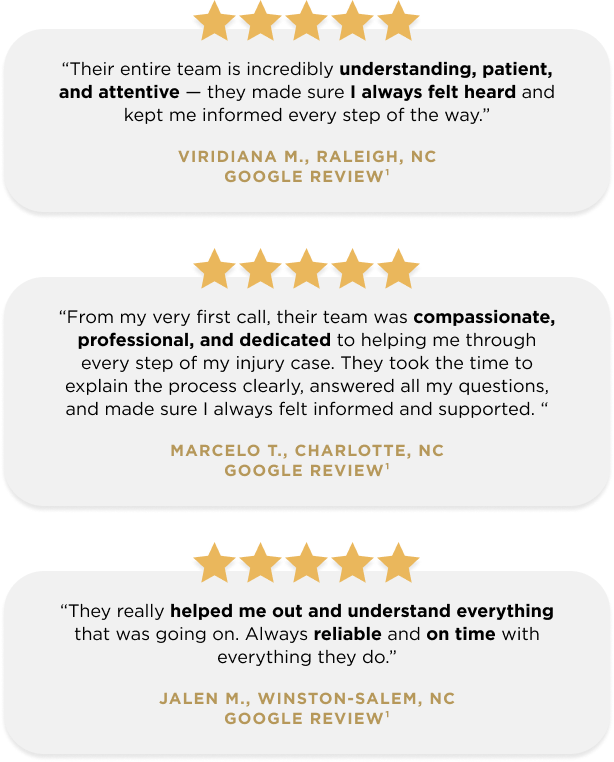
- Client feedback frequently discusses communication and support from Farrin’s attorneys and staff, such as in this testimonial:
“They handled my case with the utmost professionalism and attention to detail, making sure I was informed and reassured every step of the way.” – Marcus S., Durham, 5 star Google review¹
- We use proprietary technology and internal processes designed to help teams track case activity, deadlines, documents, and client communication.
- We have 14 offices in North Carolina, along with remote and telephone options for clients who may not be able to travel. We can also come to you.
- Our firm includes more than 60 attorneys. Individual team members have received professional recognition, authored legal materials, taught seminars, held leadership roles, and brought experience from insurance, government, defense, and other legal settings. Prospective clients can review individual biographies to determine which qualifications relate to personal injury law and their specific type of claim.
- Farrin regularly receives inquiries and referrals from other attorneys and law firms, including matters they may not have the resources, capacity, or experience to handle.
What Do Former Clients Say About Working With Farrin?
Reviews should not be the only factor used to choose a personal injury law firm, but they can provide insight into how a firm communicates, answers questions, and supports clients during the legal process.
Read Client Reviews and Testimonials
Do you need a personal injury lawyer to stand by your side and guide you on next steps? Call us at 1-866-900-7078 any time. Your case evaluation is completely free, and there is no obligation to hire us afterward. And if you choose us, there are no upfront costs – and no fee at all if we don’t win for you.²
FAQs for How to Choose an NC Personal Injury Law Firm
How do I choose the best personal injury law firm in North Carolina for me?
Review the firm’s experience with cases like yours, knowledge of North Carolina law, attorney qualifications, trial readiness, investigative resources, communication practices, fees, client reviews, results, and relevant professional recognition. You should also confirm who will handle your case and how the legal team will keep you informed.
Is a larger personal injury law firm always better?
Not necessarily. A larger firm may have more attorneys, staff, technology, investigators, and financial resources, but size alone does not show how a case will be handled. Ask who will work on your case, how responsibilities will be divided, and how the firm communicates with clients.
Who will actually handle my personal injury case?
That depends on the firm. Ask whether the attorney you initially speak with will remain involved and what work may be performed by other attorneys, paralegals, case managers, investigators, or support staff. The firm should clearly explain who will be responsible for strategy, communication, negotiation, and any litigation.
What are signs to watch for when choosing a personal injury law firm?
Warning signs may include guaranteed results, unclear fees, vague communication expectations, results shown without disclaimers, awards without an identified source.
How much does it cost to hire Farrin for a personal injury case?
Farrin handles personal injury cases on a contingency-fee basis.²